 Woonetwork
 - WOO X, WOOFi, and Crypto Liquidity
Updated -
Woonetwork refers to WOO Network, the liquidity project behind WOO X exchange trading and WOOFi onchain applications. Its product range spans spot trading, perpetual futures, yield vaults, and WOO token staking. The main choice concerns where trades run and how assets are held. WOO X uses a centralized exchange account, while WOOFi supports onchain activity. The ecosystem also includes Starchild, designed for AI-assisted strategies and decentralized trading.
Account trading and onchain swaps
WOO X exchange accounts
WOO X provides spot and futures trading through a centralized exchange account. Spot trading exchanges assets, while futures trading creates contract exposure. The platform records account balances and trading activity, and its exchange infrastructure handles orders.
WOO X has customizable trading workspaces and a Proof of Reserves and liabilities dashboard. The workspace supports order entry and market monitoring, while the dashboard presents the exchange’s reported reserve and liability information.
WOOFi wallet-based swaps
WOOFi supports token swaps through onchain liquidity pools, connecting market pricing with smart contract execution. Wallet authorization replaces the exchange-account order flow for this activity. The selected blockchain processes the transaction, and the pool supplies the liquidity required for the token exchange.
Self-custody gives the wallet holder control over signing, alongside responsibility for contract interactions. The custody model changes even when an onchain interface resembles familiar exchange trading.
Price feeds and sPMM liquidity
WOOFi’s own swap liquidity uses Synthetic Proactive Market Making (sPMM), combining pricing data with an onchain market-making algorithm. Its price feeds carry more than a reference price. Spread and liquidity parameters let the pool simulate centralized order-book conditions when quoting a trade.
The sPMM model makes trade size part of the average execution price. A market reference price alone therefore does not describe the quote for every order size.
| Pricing parameter | Definition or range | Applicable condition |
|---|---|---|
| Mid-price | (bid + ask) / 2 | Reference midpoint of the quoted market |
| Relative spread | (ask - bid) / mid-price | Spread expressed relative to the midpoint |
| Liquidity coefficient | relative slippage / quote-token amount | This definition assumes a USD stablecoin quote token |
| Rebalance coefficient | A value from 0 to 1 | Reverse trades used to rebalance pool inventory |
The rebalance coefficient controls reverse-trade pricing incentives. At 0, the model pays no slippage to the arbitrageur; at 1, it pays the full slippage.
Trading fees and price impact
WOO X applies a dynamic trading fee schedule influenced by account activity and WOO-related benefits. Spot and margin trading fees come from the currency received, so the asset deducted depends on the trade’s direction.
WOOFi swaps carry a swap fee. The sPMM quote also reflects the spread and the liquidity coefficient applied to trade size. Network transaction costs form a separate expense for onchain activity. A fee pays for a service or transaction, while price impact describes how the requested size affects execution.
How do WOO X futures and WOOFi Pro differ?
WOO X futures run within a centralized exchange account, while WOOFi Pro provides decentralized perpetual trading through Orderly Network.
WOO X futures markets
WOO X combines futures with exchange-account custody and its own fee schedule. Its perpetual-trading fees are deducted in USDT. Depositing funds into that account places them within the centralized exchange service, a different arrangement from the contracts and infrastructure behind WOOFi Pro.
WOOFi Pro and Orderly Network
WOOFi Pro uses a limit order book built on Orderly Network’s shared infrastructure. Orderly manages collateral, available markets, liquidity provision, order matching, and risk management. WOOFi Pro uses USDC collateral. WOOFi supplies the trading interface, combining an exchange-style order book with a decentralized custody model.
WOO X operations after the FusionX Digital announcement
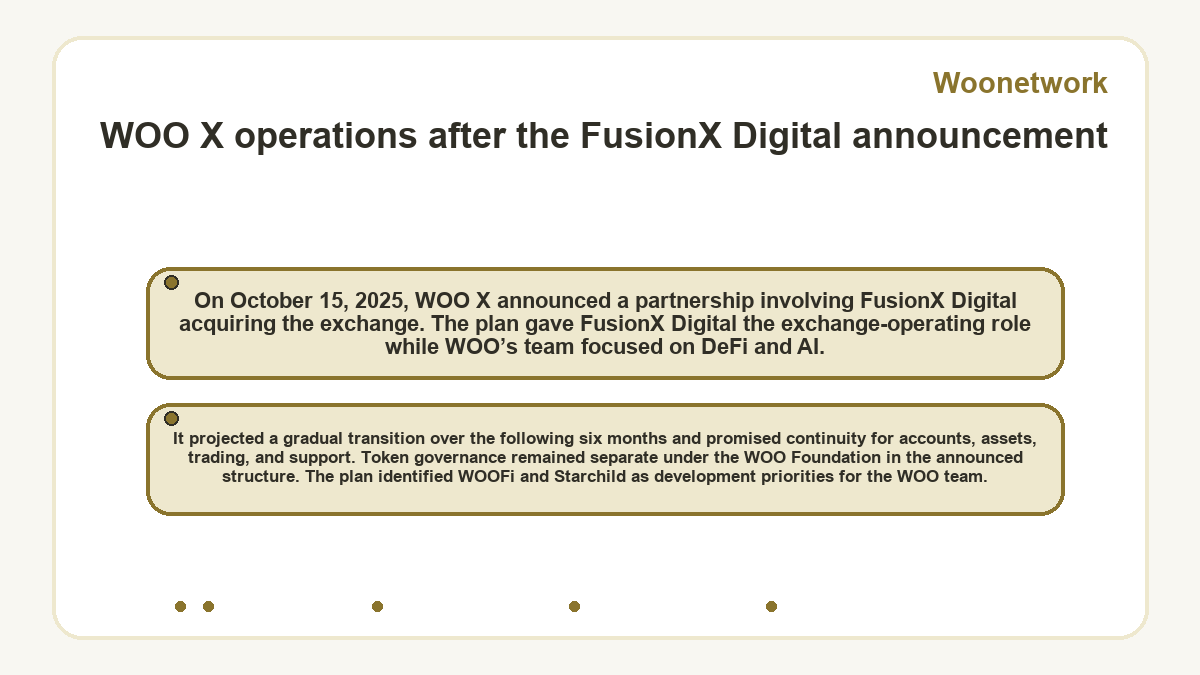
On October 15, 2025, WOO X announced a partnership involving FusionX Digital acquiring the exchange. The plan gave FusionX Digital the exchange-operating role while WOO’s team focused on DeFi and AI. It projected a gradual transition over the following six months and promised continuity for accounts, assets, trading, and support. Token governance remained separate under the WOO Foundation in the announced structure. The plan identified WOOFi and Starchild as development priorities for the WOO team.
What role does the WOO token play?
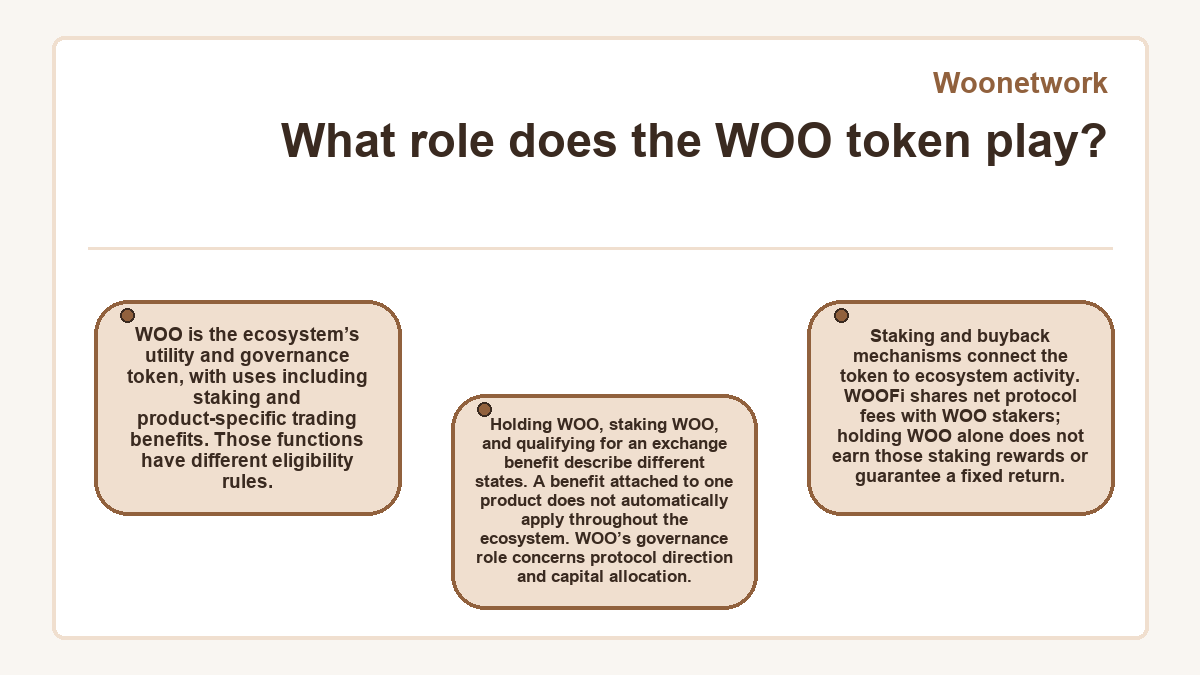
WOO is the ecosystem’s utility and governance token, with uses including staking and product-specific trading benefits. Those functions have different eligibility rules. Holding WOO, staking WOO, and qualifying for an exchange benefit describe different states. A benefit attached to one product does not automatically apply throughout the ecosystem. WOO’s governance role concerns protocol direction and capital allocation. Staking and buyback mechanisms connect the token to ecosystem activity. WOOFi shares net protocol fees with WOO stakers; holding WOO alone does not earn those staking rewards or guarantee a fixed return.
Staking rewards and earn vaults
WOO Stake
WOO Stake lets holders stake WOO on supported networks and earn rewards in USDC. The application manages combined staking positions, XP, and staking rewards on Arbitrum. LayerZero integration supports staking interactions from other supported networks, while the reward accounting remains coordinated.
XP is non-tradable and increases staking weight when staked. Time and qualifying activity can increase it, while unstaking affects the staked XP retained. Reward weight therefore differs from the amount of uncommitted WOO a wallet holds.
WOOFi Supercharger vaults
WOOFi’s Supercharger vault design lends deposited assets to its sPMM liquidity manager. Borrowing interest supports yield, while the manager handles quotes and hedging. Asset suppliers participate in liquidity provision, a different activity from exchanging tokens through the pool.
These vaults combine settlement-based withdrawals with limited instant withdrawals. Uncollateralized borrowing creates exposure to the pool manager, alongside smart contract and hedging risks. Delegating impermanent-loss management changes who handles that exposure, while leaving those dependencies in place.
Crosschain access within supported routes
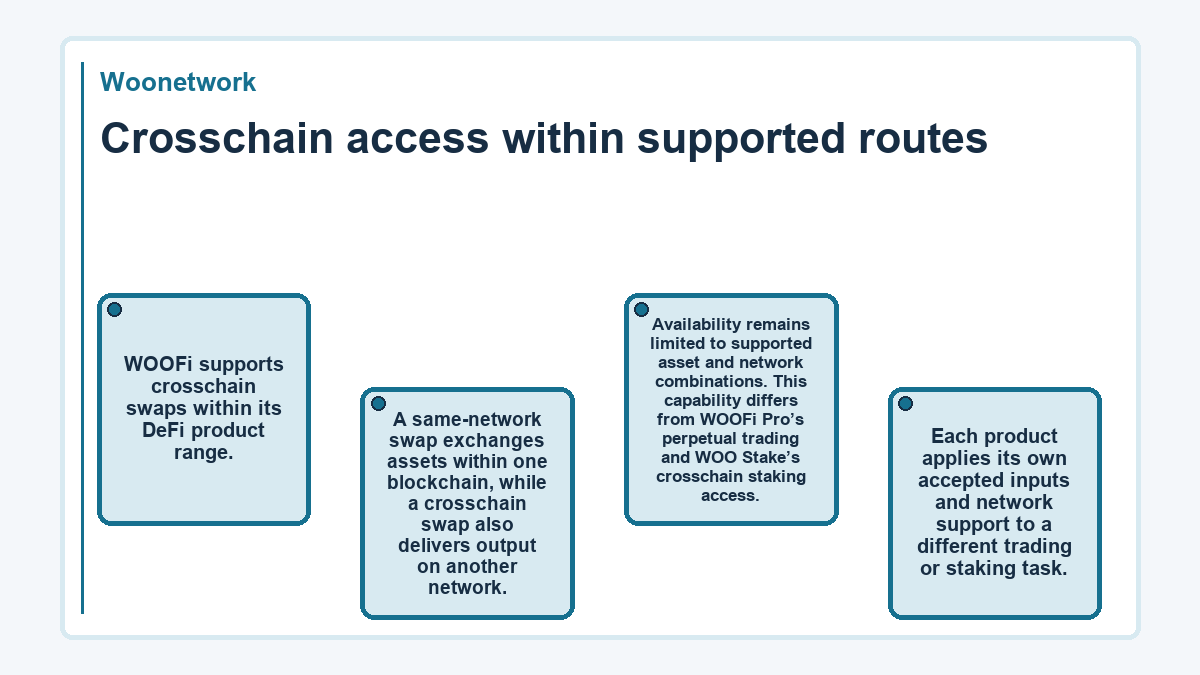
WOOFi supports crosschain swaps within its DeFi product range. A same-network swap exchanges assets within one blockchain, while a crosschain swap also delivers output on another network. Availability remains limited to supported asset and network combinations. This capability differs from WOOFi Pro’s perpetual trading and WOO Stake’s crosschain staking access. Each product applies its own accepted inputs and network support to a different trading or staking task.
Starchild and AI-assisted market work
Starchild focuses on curating market signals, strategies, and actions across decentralized finance. WOO’s October 15, 2025 announcement described Starchild as a closed-beta platform for strategy creation and execution on decentralized exchanges. Its role complements applications supplying liquidity and trading infrastructure.
A strategy proposal describes an intended action; execution takes place under the selected application’s market and transaction rules. The intelligence layer changes how an action is prepared, while the connected product determines what trade it can execute.
From Wootrade to WOO Network
Kronos Research founded Wootrade in 2019 to give exchange clients access to a shared liquidity pool. The original business addressed exchange liquidity, including order-book depth and trading spreads. The early network combined order matching and routing with liquidity from exchanges and market makers. The WOO token followed in late 2020, and the product range expanded to WOO X and WOOFi in 2021. The August 16, 2021 rebrand adopted WOO Network as the broader identity while retaining Wootrade for the institutional liquidity gateway. That naming distinguished the overall network from the services using its liquidity. The 2021 product lineup also included the early-stage investment arm WOO Ventures.
Woonetwork: frequently asked questions
Did the 2024 WOO X platform move change login credentials?
WOO X announced that existing login credentials and wallet addresses would remain unchanged during its 2024 platform move. The scheduled change was September 22, 2024, at 05:00 UTC. Its transition instructions called for saving chart settings because charts would reset, updating saved links, and reviewing API integrations.
Where is my current WOO X trading fee displayed?
WOO X displays the account’s current trading fee in My WOO. The All tier perks control provides details, and mobile users can reach fee information through the account page. Account activity and WOO-related benefits influence the dynamic fee schedule, so rates can differ between accounts and market types.
Are WOOFi Supercharger withdrawals always immediate?
WOOFi Supercharger vaults offer instant withdrawals only outside settlement and within the remaining weekly allowance. Instant withdrawals carry a fee. The vault design sets a 7-day cycle and a 24-hour settlement window afterward. Standard withdrawal requests also require the vault to be outside settlement; requested assets become withdrawable after the next settlement completes.
Does WOOFi Pro provide an API for automated trading?
WOOFi Pro provides an API for external applications and custom trading tools. Its integration uses an account ID and Orderly API credentials, and CCXT includes a WOOFi Pro integration. These tools concern WOOFi Pro perpetual trading; an API similarity with WOO X does not make the products or their credentials interchangeable.
What happens to staked XP when WOO is unstaked?
Unstaking WOO burns the same percentage of staked XP as the percentage of WOO removed from the staking position. The burn is proportional, so a partial withdrawal does not mean every staked XP unit disappears. XP is non-tradable and increases staking weight when staked; it remains distinct from the WOO tokens being unstaked.
Can an aggregator route trades into WOOFi liquidity?
Wallets, applications, and aggregators can route order flow into WOOFi liquidity. WOOFi pays its broker rebate to the integration referring the trade. The trader’s access point can therefore differ from the underlying liquidity source, and a broker rebate does not automatically create a cashback entitlement for the trader.