 Woonetwork
 token utility: staking rewards, XP, and unstaking choices
Updated -
Woonetwork token utility links WOO staking with protocol-fee rewards, trading benefits, and governance across the WOO ecosystem. On WOOFi, staking creates a reward-bearing position, while staked XP adds weight to its share of net fees. Unstaking WOO removes a matching percentage of staked XP. USDC rewards can remain claimable or convert into additional staked WOO, depending on the compounding setting. WOO X provides an exchange-managed staking option with separate eligibility and redemption terms. The choice concerns the reward asset, access to funds, and XP consequences. A displayed XP annual percentage rate describes point accrual rather than a promised USDC return.
WOO, XP, and USDC in a staking position
WOOFi staking connects a WOO position to protocol-fee distributions paid in USDC. The allocation to stakers equals 80% of WOOFi’s net fees from swaps and perpetual trading. This percentage describes the collective fee allocation, not an annual return on each deposited balance. An individual position earns according to its staking weight and the fees available for distribution. Staking XP increases that weight, with each point counting like one additional staked WOO. XP remains non-tradable even when it contributes to rewards.
Keeping WOO in a wallet does not activate these benefits because the tokens must form part of an eligible staking position.
Direct WOOFi staking supports Ethereum, Arbitrum, BNB Smart Chain, Optimism, Polygon PoS, and Avalanche. Combined positions, XP, and rewards operate on Arbitrum through LayerZero integration. Crosschain staking therefore requires extra gas tokens on the source chain to cover Arbitrum operations. The USDC reward APR remains the same across supported staking chains. The destination of a crosschain swap needs staking support before its WOO balance can enter the reward system.
Staking parameters and access limits
WOO Stake v2 and WOO X apply different redemption rules. XP accrual, reward weighting, and access to unstaked balances follow the relevant product terms.
| Parameter | Documented value or rule | Effect or eligibility condition |
|---|---|---|
| XP reward weight | One staked XP counts like one staked WOO | Contributes to fee sharing; XP remains non-tradable |
| Base XP accrual | 30% APR before ratio-based reductions | Measures XP growth, separately from USDC rewards |
| WOOFi unstaking | Staked XP falls proportionally to WOO unstaked | Reduces the position’s reward weight |
| WOOFi auto-compounding | Cannot be disabled within seven days of activation | Separate staking-reward claims remain unavailable while enabled |
| WOO X standard unstaking | 24-hour settlement with no unstaking fee | Requested WOO stops earning yield; cancellation remains possible before settlement |
| WOO X instant unstaking | 5% of the unstaking amount; minimum 300 WOO | Immediate Spot Wallet settlement; irreversible after confirmation |
XP accrual and recurring challenge conditions
Ratio-based XP accrual
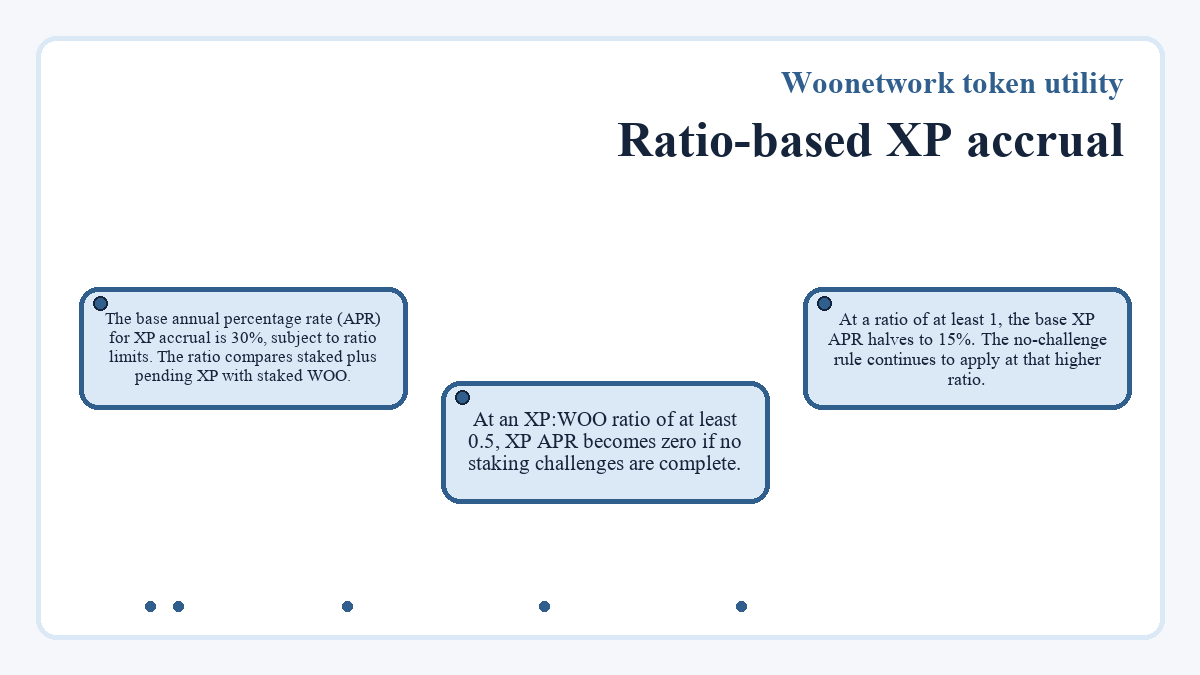
The base annual percentage rate (APR) for XP accrual is 30%, subject to ratio limits. The ratio compares staked plus pending XP with staked WOO. At an XP:WOO ratio of at least 0.5, XP APR becomes zero if no staking challenges are complete. At a ratio of at least 1, the base XP APR halves to 15%. The no-challenge rule continues to apply at that higher ratio.
Recurring challenge eligibility
Recurring challenges require at least 1,800 WOO staked, alongside the applicable activity requirements. The documented challenge ceiling reaches 76.05% XP APR when the unreduced base and full challenge multipliers apply. Ratio-based reductions change that starting base, so the headline ceiling cannot describe every staking position.
Trading activity
Qualifying spot activity must use WOOFi’s Synthetic Proactive Market Making (sPMM) liquidity. Perpetual trading on WOOFi Pro supplies the alternative trading route for this challenge. The trading challenge provides a 1.3 multiplier, and its required volume varies with staking tier.
Vault deposits and auto-compounding
Maintaining the required balance in WOOFi Supercharger vaults supplies a separate 1.3 multiplier. The deposit threshold follows the staking tier. Auto-compounding provides a further 1.5 multiplier, with its own reward-access restriction.
USDC claims and daily compounding
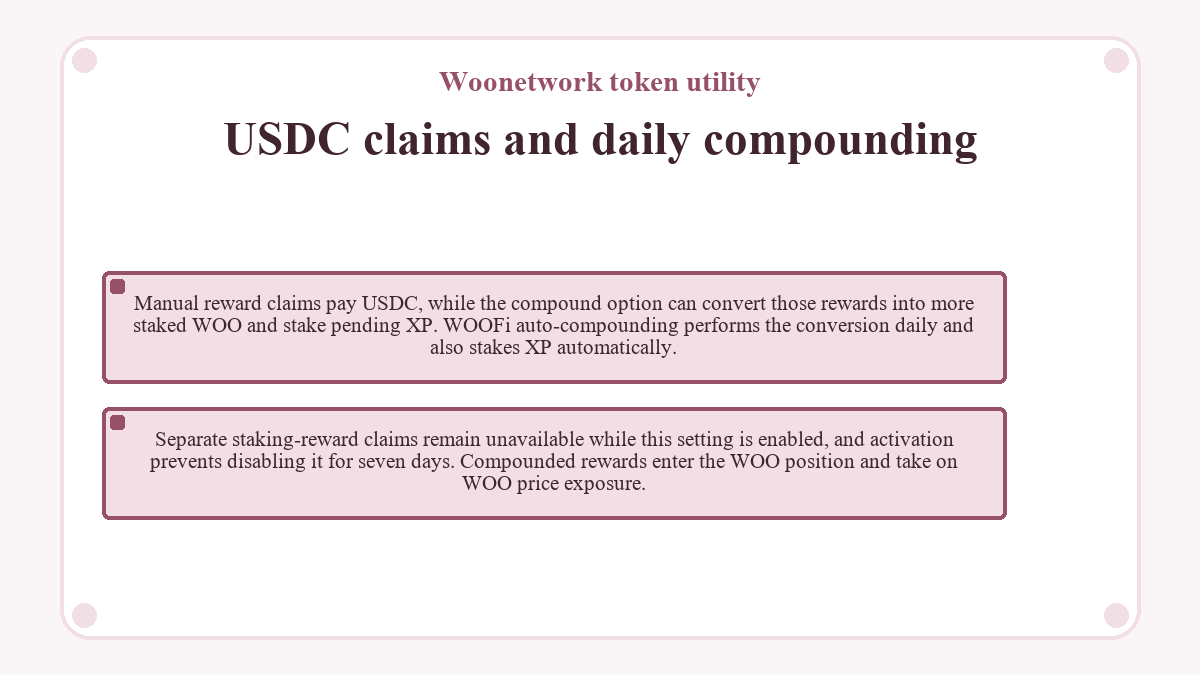
Manual reward claims pay USDC, while the compound option can convert those rewards into more staked WOO and stake pending XP. WOOFi auto-compounding performs the conversion daily and also stakes XP automatically. Separate staking-reward claims remain unavailable while this setting is enabled, and activation prevents disabling it for seven days. Compounded rewards enter the WOO position and take on WOO price exposure.
Partial unstaking and proportional XP loss
WOO Stake v2 allows unstaking without a fixed staking lockup. Unstaking a fraction of a WOO position burns the same fraction of its staked XP. The denominator is the WOO stake immediately before unstaking, excluding wallet holdings and the USDC reward balance.
The proportional relationship can be written as: XP removed equals staked XP multiplied by WOO unstaked, divided by WOO staked before unstaking. A partial exit therefore removes part of the accumulated reward weight alongside the WOO leaving the position. A complete exit removes the corresponding staked XP.
The absence of a fixed staking lockup does not make crosschain processing instantaneous. Completion depends on the source chain and network status. Those processing conditions differ from WOO X’s exchange settlement options.
WOOFi Pro benefits and WOO X staking
Trading fee benefits
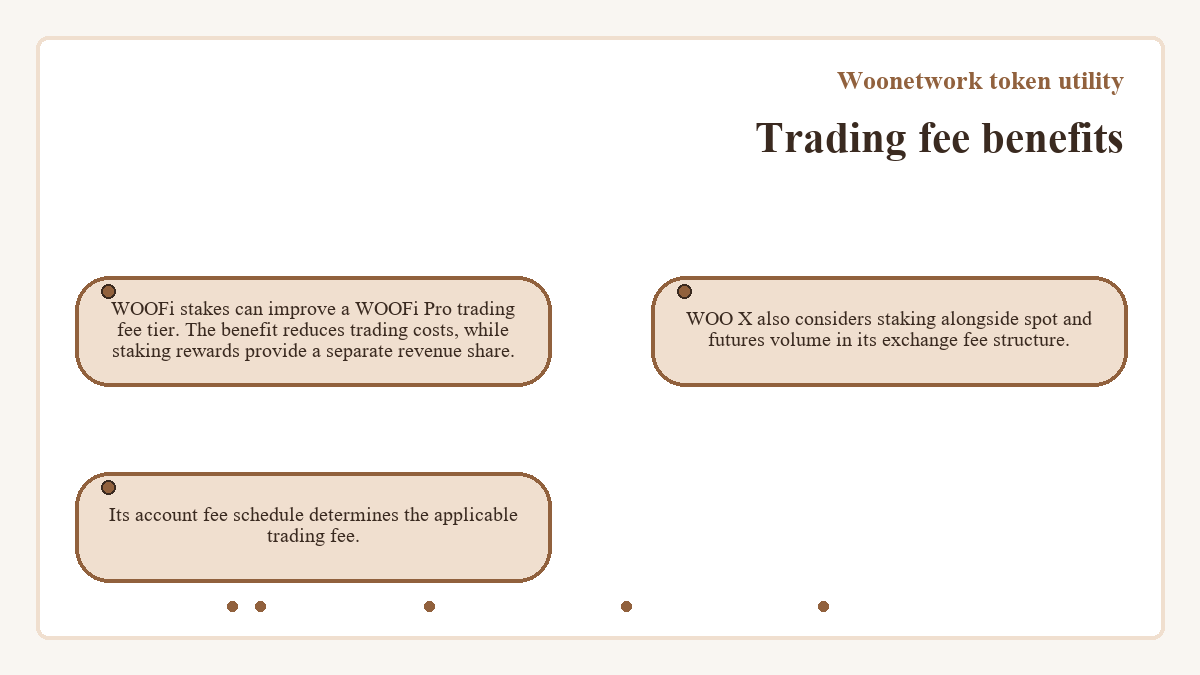
WOOFi stakes can improve a WOOFi Pro trading fee tier. The benefit reduces trading costs, while staking rewards provide a separate revenue share. WOO X also considers staking alongside spot and futures volume in its exchange fee structure. Its account fee schedule determines the applicable trading fee.
Exchange-managed staking
WOO X pools its users’ staking positions through a unified WOO Stake position. Access requires level 1 identity verification and a supported jurisdiction. WOO X has discontinued its own staking challenges; direct WOOFi challenges operate under the onchain staking rules.
WOO X lets users enable or disable automatic compounding of their daily WOO yield. Enabled compounding adds rewards to the staking position; disabled compounding sends daily yield to the Spot Wallet. The WOO requested for standard unstaking stops earning yield during settlement. Instant unstaking deducts its fee from the WOO being redeemed.
Governance, token burns, and campaign benefits
WOO also functions as a governance asset for protocol direction, capital allocation, and ecosystem priorities. XP contributes staking reward weight and related benefits, without replacing WOO as the governance asset.
On October 15, 2025, WOO announced FusionX Digital’s planned acquisition and operation of WOO X, with a gradual transition expected over six months. The announcement described separate WOO Foundation governance of the token.
WOOFi offers quest-based Boosters and Stake Surge airdrops alongside its fee-sharing rewards. Boosters are ERC-1155 NFTs providing temporary increases to XP accrual, with effects varying by rarity and staking level. Stake Surge applies its own scoring system for airdrop allocations.
The burn mechanism introduced in June 2024 specified monthly burns from the ecosystem rewards allocation, matching the number of WOO tokens bought back through staking rewards. This supply burn removes ecosystem tokens. Unstaking burns XP from a staking position, reducing its reward weight.
Useful questions about Woonetwork token utility
When does a completed WOOFi challenge change the displayed XP APR?
WOOFi’s XP APR updates one day after a qualifying challenge is completed. Challenge status appears in the staking interface. Trading and vault challenge eligibility requires the volume or vault balance for the position’s staking tier, so performing an activity does not establish that its threshold has been met.
What happens to XP earned with a WOOFi Booster when its boost expires?
XP generated during a Booster’s active period remains after the temporary boost ends. The Booster item is automatically burned when its effect finishes. The retained XP continues under the ordinary staking rules, including the proportional XP reduction associated with unstaking WOO.
Can a WOOFi Pro fee tier improve without additional WOO staking?
A WOOFi Pro fee tier can also improve by meeting that tier’s 30-day trading-volume requirement. Staking WOO and reaching qualifying volume are alternative routes described for tier advancement. The fee tier shown in the trading account identifies the applicable trading benefit.
Is a legacy WOOFi v1 position automatically covered by WOO Stake v2?
Legacy wallet-based WOOFi v1 stakes require migration to v2 to continue earning rewards under the newer system. The migration procedure offers automatic and manual routes. An interrupted automatic migration requires the manual route; its legacy withdrawal procedure waives the former seven-day unstaking period and penalty fee.
Does staking bridged WOO eliminate its underlying bridge risk?
Staking bridged WOO does not eliminate the token representation’s bridge dependency. Ethereum hosts the canonical WOO token, while representations on other chains depend on backing held through the relevant bridge arrangement. That dependency can affect redemption of the underlying WOO on Ethereum, alongside the staking product’s own conditions.
How does Stake Surge determine a staker’s airdrop allocation?
Stake Surge uses a Surge Score to determine a staker’s airdrop allocation. Accumulating XP raises the score, and completing campaign tasks can unlock score multipliers. The campaign’s allocation process is separate from the ordinary USDC fee-sharing reward.